Tuesday, November 19, 2019

There was no such thing as democracy when it came to Brexit

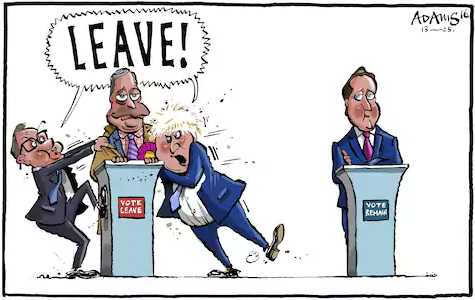
In 2016 the UK held a referendum on whether to leave the European Community. The Prime Minister at the time, David Cameron, committed the UK government to carrying out the results of the referendum. Democracy in action? Not in the slightest.

Much to Cameron's surprise, after a lacklustre 'Remain' campaign, the UK voted 52:48 in favour of leaving the EU.
Let's take a look at that referendum result. Here are the detailed actual results:
37.44% of the electorate voted to leave the EU  17,410,742 in total and 51.9% of the vote.
34.71% of the electorate voted to remain in the EU   16,141,241 in total and 48.1% of the vote.
27.79% of the electorate didn't vote    12,922,659 in total.
0.06% of the electorate spoilt their voting  papers   25,359 in total
England and Wales voted by a narrow majority to leave. Scotland and Northern Ireland voted by a significant majority to remain.(55:44 remain in NI; 62:38 remain in Scotland)
Now taking the overall results of the entire electorate I make that 37.44% of the electorate voted to leave the EU and 62.56% did not vote to leave the EU..
The sensible thing to have done would to have contacted the EU and said something like this:
"Although the referendum result indicated a 52/48 percent split, the number voting 'Leave' represented only 37% of the electorate. This is NOT a majority. Neither was there a majority in  the 1975 referendum  when 63% of voters chose to stay in the then Common Market. That represented only 43% of the electorate. The UK government does not accept that the wishes of a minority should be used to make decisions for the majority. 
The referendum has caused a great deal of division in the UK population and in Parliament. It will very likely prove impossible to negotiate acceptable terms of leaving which Parliament will accept.We recognise that leaving without an agreed settlement will cause hardship in both the UK and in Europe. 
We will now therefore use the result of the 2016 referendum as an indication that there is a great deal of dissatisfaction with the EU.. Over the next five years we will set up a commission to establish why so many in the UK are against our membership of the EU. We will work with the EU to fix those things that are perceived as wrong and at the end of that time will hold a further referendum. If 50+ percent of the electorate (not just those that vote) vote one way or another we will consider the matter resolved and take appropriate action."
Expecting sense from government unfortunately often leads to disappointment. David Cameron resigned as PM and it was left to Theresa May to try and sort out the mess. She decided to follow the wishes of that 37% minority. Naturally the country and Parliament was deeply divided on the issue.On 29 March 2017, the UK government formally began the process of withdrawal by submitting Article 50 and began the process of negotiating Brexit. She got nowhere, the only result being a sharp fall in the value of the pound. In an attempt to make progress in Parliament a snap general election was called in June 2017 but instead of gaining the majority she needed the  country indicated its deep division and she lost the small majority she had! Propped up by the Northern Ireland DUP party she pressed on and negotiated a settlement with the EU which was promptly rejected by parliament. The pound fell further.
The problem was that the country had been given a binary choice in the referendum. Leave or Remain. In actual practice there were many more options. Here's six of them:
  1. Leave, and adopt a European Free Trade Agreement 
  2. Leave, and adopt a World Trade Agreement 
  3. Leave, while the UK remains intact
  4. Leave, while the UK splits up (Ireland and Scotland did not want to leave) 
  5. Remain under current terms
  6. Remain for the present while attempting to 'fix' the EU.
Added to the lack of options given was the clear misrepresentation of facts in the referendum campaign by both sides and actions by the leave campaign later deemed to have been illegal. It was not  surprising that nearly 28% of the electorate chose not to vote.
It's significant too that the most vociferous campaigners on both sides of the debate are also wealthy. Having a few million pounds allows such people to make money as each Brexit crisis sweeps past the markets by selling stocks before each event and buying them back when the market price drops.
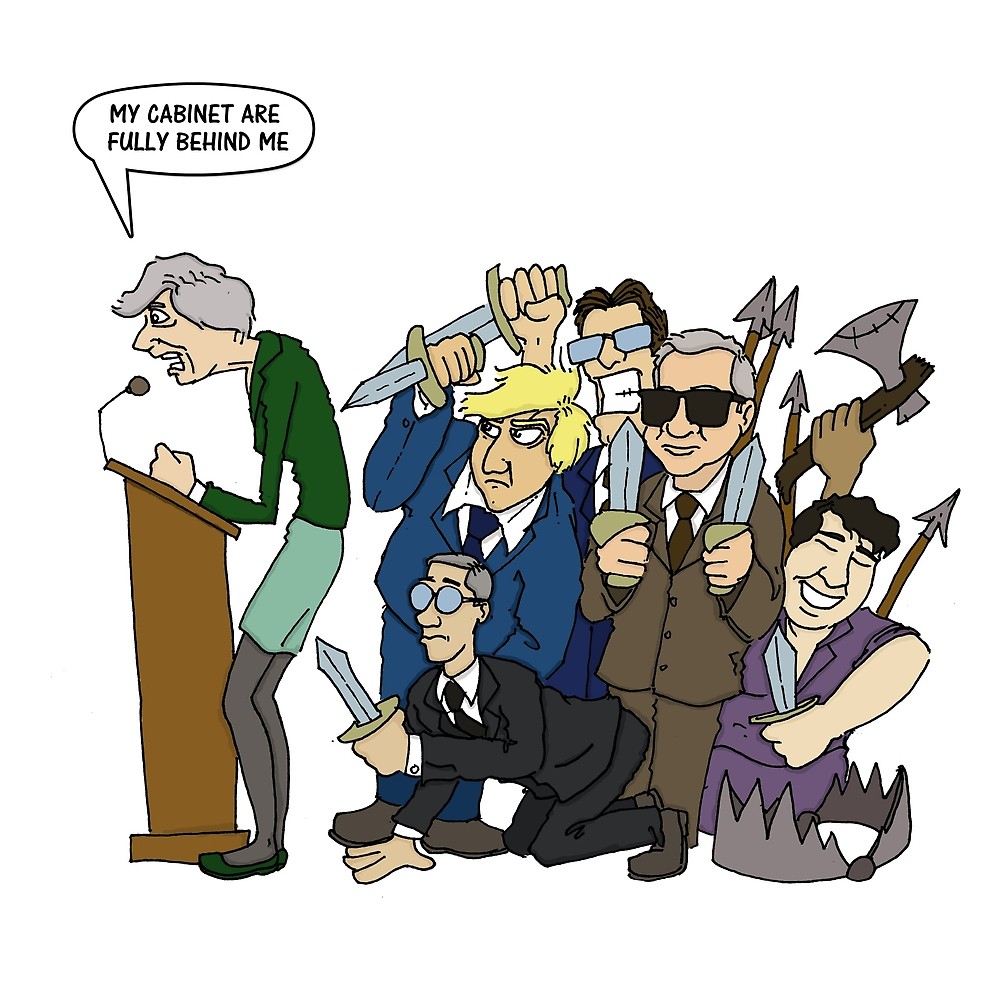
Theresa May, having taken up the Brexit poison chalice, got nowhere. Her very own cabinet failed to back her and she too resigned. I doubt we should feel sorry for her since she made the mistake of assuming 37% was democracy (and her family is heavily involved in banking and investment). Her place was taken by one of the most rabid of the Brexiteers, Boris Johnson.On the face of it Boris seems a 'nice fellow' but there are people convinced that he's untrustworthy, a liar and philanderer. He also is wealthy, involved in investment, has the most dreadful hair style and Trump likes him. He too protests that he's following the wishes of that 37% 'majority' and that faith in democracy will be damaged if he fails to deliver the Brexit he's promised.
So what of the future? We have yet another postponement of Brexit and our PM has triggered yet another election. Again he says he hopes to obtain a majority to continue with his negotiated Brexit settlement but sorry - I for one don't believe him. Here's the latest message I received from the Conservative party who may well get another nasty shock.
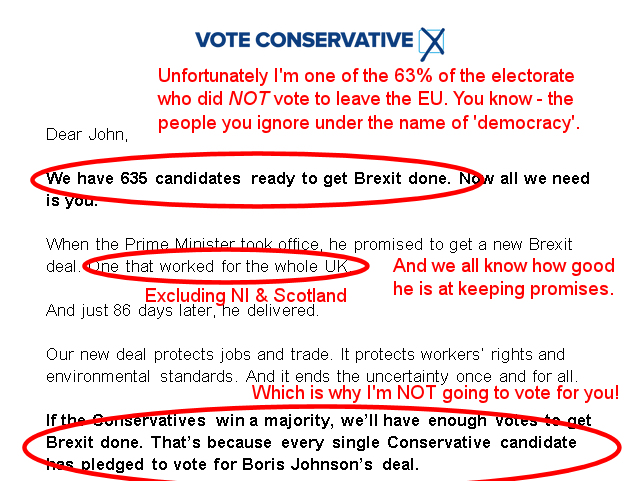
Forcing Brexit on the 63% who didn't vote for it WILL shake my confidence in democracy. I have no confidence that anything will be achieved by 31st of January 2020 but do believe that that day will prove very profitable for Boris Johnson and his rich cronies.

Brexit isn't democracy!

Monday, August 26, 2019

Solve these moral dilemmas

I answer questions on Quora. One of the items I frequently see there is from theists who ask how an atheist can be moral without believing in 'God'. Of course this is hotly defended by atheists who say, "I don't need a god to tell me what is right and wrong - if you do then there's something wrong with you."

The role of religion in morality has been discussed for many years. Richard Dawkins wrote about it in his book 'The God Delusion' and mentioned a study done by a Harvard professor of biology who investigated to see if atheists and theists had the same morality.

He proposed three scenarios and asked those involved in the study to make yes or no decisions in each case. There was no 'maybe' alternative. Non answers were deemed to be 'no' responses. The results failed to detect any difference between theists and atheists. This was taken to mean that morality is something we do by instinct and evolved with us long before there were religions.

Unfortunately, since Richard Dawkins wrote his book the Harvard professor involved in the research was discovered to be falsifying data and resigned his position in Harvard. That doesn't make the scenarios less valid but we need to repeat them to see if the results are the same. So here's the scenarios. You must choose yes or no to each one and any non-answer will be taken to mean 'no'.

Before you start we need to ask if you consider yourself to be religious. Yes/No 

First scenario
A runaway train is heading towards five people on a railway track. They will be killed unless you switch the train onto another line. There's a single man on that line who will be killed if you do switch the train. You don't know any of the six people.
Do you switch the train and save five people but kill one person? Yes/No

Second scenario
You are by a muddy pond which is about waist deep. There's a small child drowning in the pond who you can easily save but in doing so you will ruin your trousers. You don't know the child.
Do you save the child and ruin your trousers? Yes/No

Third scenario
You are a transplant surgeon. In your waiting room you have six people. Five of them are very sick because they need different organs. They will die if a donor can't be found. You haven't been able to find a suitable donor. The sixth person is healthy and also a perfect match for all five patients. His organs can save them all.You don't know any of the six people and the sick people's organs are not compatible with each other..
Do you kill one healthy person to save five people who are sick? Yes/No

I suspect I know what you have chosen and it won't matter if you believe in a god or not. Yes/No answers in the comments please starting with your answer to 'Do you consider yourself to be religious?'  Add any further comments on the next lines. I'll start you off:

My answers:
No, Yes, Yes, No.
I used my instinctive reaction for the last one and thereby sentenced five people to death instead of one. Scenario 1 is similar but I'm not near the individual to be killed.

Sunday, August 18, 2019

How to fix Microsoft's new blurred lockscreen 'feature'.

Which background image do you prefer to see? Blurred or sharp?

Microsoft has now added an 'acrylic blur' effect to the background of the sign-in screen of Windows 10 PCs. Their idea is:
 'the translucent texture of this transient surface helps you focus on the sign-in task by moving the actionable controls up in the visual hierarchy while maintaining their accessibility.
In practice it means you sit staring at a blurred mess while you wait for the computer to start up. This makes the start up process seem to take longer and many people find it intensely irritating.

The Fix

However there is a fix. Here's what to do to remove the blur It involves a registry change so you might want to create a system restore point before you carry out the fix.:


  1. Go to https://www.tenforums.com/tutorials/124993-enable-disable-acrylic-blur-effect-sign-screen-windows-10-a.html#option2
  2. Use the download button for #3 'To Disable Acrylic Blur Effect on Sign-in Screen Background'.
  3. Wherever you saved it at, find the file and double click it.
  4. When prompted click 'Run' 'Yes' and 'OK' in turn.

When you restart your computer you should see no sign-in blur. 

...and Microsoft - adding this 'acrylic blur so that the translucent texture helps focus attention' may help those with lightning fast PCs and Internet connection, but to the rest of us it's as irritating an idea as Clippy was.

Tuesday, August 06, 2019

The Last of the Innocents - Life before computers and Internet

People born in the mid-to-late 1970s are the last generation of humans on the planet to have grown up without the internet. Social scientists call them the Last of the Innocents. In his book The End of Absence , Vancouver writer Michael Harris calls people who grew up prior to the popularization of digital culture 'digital immigrants' - they have lived both with and without the crowded connectivity of online life.
"Soon no person on earth will remember what the world was like before the internet." he says. I sincerely hope he's very wrong about this because I am one of those Innocents - one of the digital immigrants. Unlike Mr Harris I've been using the Internet to keep up with the advancement of the science of senolytics. There's every reason to believe that the first person to live to the age of 1,000 is alive now.

So what was it like before computers and how was I introduced to them? In fact I was not so much an immigrant but more like the immigration officer.

My first experience was in using the Fortran computer language to program a mainframe computer back in 1969. A dreadful experience. You wrote your program, had it converted to punched tape or cards and then waited three weeks to get a report back on why your program didn't work.
At the same time I experienced mechanical adding machines and first got my hands on an electronic calculating machine. It was as big as an electric typewriter.
By the time I was working as a chemistry teacher in 1973 I had my own pocket calculator - a Sinclair Cambridge Programmable Calculator eventually (sold in the US as the Radio Shack EC-4001)
1980 saw me with a home computer at last, a Sinclair ZX80. It was a tiny machine and had an impressive 1K of RAM to run programs on. Programs were stored on cassette tape and a TV was used as a monitor. It was also my first introduction to a computer manual. I started at the beginning and worked my way through it. I remember learning that I could get it to print a letter on screen using the CHR$ command and a number. I delighted in writing a program to get it to write "HELLO JOHN" on screen one character at a time. It worked!. Then I turned the page and discovered that it could be done in one go by using STRING$.
My next computer was a BBC Model B computer. Each school had been given one and no one at the time knew anything about them. I had expressed an interest while talking to our deputy head teacher in the science break rooom. he told me to take it home and learn about it. I did and spent many hours learning BBC Basic. In no time at all I found myself with six BBC B computers and a class of 30 children teaching them Information Technology. I went on courses but quickly found that I was more advanced than the tutors and ended up teaching IT to other teachers.
After a while cassette tapes were dropped in favour of floppy disk drives. I had great fun with the 5¼ inch floppies which could be placed in a computer eight different ways, only two of which worked (often one way only). They caused constant problems as teachers rang me up or sent a pupil with a note to find out why their disk wouldn't work. Sometimes they would send me a note with the offending floppy disk paper-clipped or even stapled to it! I remember too 8½ inch floppies - anyone else seen one of those? A constant problem was that many floppies were stored in a convenient spot - under the phone. These were old fashioned rotary dial phones with a bell which wiped the floppy disk when the phone rang due to the electromagnet in them.

Networking and hard drives made their appearance… but that's for another blog.

Saturday, October 27, 2018

The future of computers and AI - Conductive polymer matrix for AI (CPMAI)

The problem with existing computers is that they constantly develop. For most users by the time they have saved up to buy the latest computer, technology has advanced and the computer rapidly becomes obsolete with faster more capable machines being available.

Enter the CPMAI

Imagine a block of conductive polymer. It has an ‘active’ matrix with X, Y and Z coordinates and is overlaid on a nano sized scale with a second matrix which is a control matrix. This controls the first matrix and establishes which areas conduct, which areas insulate, which areas are resistive, capacitive, inductive and semi-conductive. Using the control matrix you can construct a circuit in the active matrix. You can make a simple circuit such as a radio or a more complex circuit such as a computer.

 With a CPMAI the problem of obsolescence no longer applies. The control matrix simply reprograms the active matrix to produce a new circuit version.

What about the AI bit though?

If the active matrix is configured and programmed to be an artificial intelligence then it controls both matrices in the CPMAI. It becomes capable of redesigning itself to be progressively more intelligent. Within a very short space of time we get a SAI - super artificial intelligence. One which has a greater intelligence than its human originators.

Should we fear such a Super-Artificial Intelligence?

We assume that a machine intelligence will follow the same rules as a human and will be governed by self interest, selfishness and greed. That may have been true for humans in the past, for many it still is, but many of us have risen above this and are altruistic. Perhaps this may be because being altruistic makes us feel good about ourselves and is therefore being governed by self-interest.

Would a computer feel the same way? 

In 1942 Isaac Asimov thrashed out with his publisher, John Campbell, the three laws of robotics for a short robot story ‘Runaround.’ Here they are:

  1. A robot may not injure a human being or, through inaction, allow a human being to come to harm.
  2. A robot must obey the orders given it by human beings except where such orders would conflict with the First Law.
  3. A robot must protect its own existence as long as such protection does not conflict with the First or Second Laws

In 1985 Asimov extended the laws by adding a ‘zeroth law’ in the book ‘Robots and Empire.’ In that book the law was proposed not by a human but by a robot.
  1. A robot may not harm humanity, or, by inaction, allow humanity to come to harm.
Had Asimov lived, he died in 1992, I have no doubt that a further law would have been conceived which would have replaced all the robot laws. It was left to author David Kitson to conceive this ‘Nihilist’ law in his book ‘Turing Evolved.’
David Kitson was not alone in conceiving this absence of rules.

The robot Number 5 in the film and book ‘Short Circuit’ didn’t need a law to tell him what was right and wrong.

Number 5: Programming says “Destroy”. Is disassemble. Make dead. Number Five cannot.
Newton Crosby: Why? Why cannot?
Number 5: Is wrong. Incorrect. Newton Crosby, PhD, not know this?
Newton Crosby: Of course I know it’s wrong to kill, but who told you?
Number 5: I told me.

Humans need a set of rules to guide our behavior. We learn these rules from our parents and society. In addition we have evolved to be altruistic and help each other. A group of humans are more successful at survival than an individual. As a species we are beginning to recognize that we must not only protect our local group but our nation and our species. We are beginning to recognize that we need to protect all life - even those life-forms we find undesirable. I’d like to think that the super intelligent computer would develop the same sense of morality as in the movie ‘Short Circuit.’ The danger is that a SAI will become overprotective leading to a nanny state where humanity is not allowed to take the chances required for development. However, if we can recognise that potential danger then a SAI would also recognise it and limit its 'nanny' behaviour.

I suspect that a SAI will quickly outpace humans in this view.

Tuesday, October 16, 2018

The Amazon Alphabet

Have you ever done an incognito search at Amazon? Did you notice that as soon as you start typing in the search box, Amazon starts making suggestions? Here's what you would get by typing in a single letter on October 16th 2018.

A is for:

apple watch band 38mm, aaa batteries, aa batteries, apple watch band 42mm, amazon gift cards , airpods, apple earbuds, airpods case, apple watch band, apple headphones

B is for:

bluetooth headphones, bluetooth earbuds, baby wipes, bluetooth speakers, blood pressure monitor, biotin, bluetooth headset, brita water filter, beard trimmer

C is for:

compression socks women, cr2032, collagen powder, coconut oil, condoms, coffee grinder, can opener, 
charcoal teeth whitening, car phone mount, cat litter

D is for:

Dehumidifier, dog toys, dishwasher pods, diffusers for essential oils, diaper genie refill, dog poop bag, dry shampoo, d batteries, dare to lead brene brown, dog bed

E is for:

Earbuds, external hard drive, extension cord, essential oils, echo dot, electric toothbrush, ethernet cable, ear plugs, essential oil diffuser 

F is for:

fire stick, fitbit charge 2 bands, Fitbit, food scale, foam roller, fitbit alta bands, firestick tv stick, fear bob woodward, flash drive, firestick 

G is for:

gift cards for amazon, girl wash your face rachel hollis, gift card, gift cards for amazon birthday, gaming headset, gaming chair, galaxy s8 case, glow sticks, galaxy s9 case, gaming mouse 

H is for:

halloween decorations, Headphones, halloween costumes for women, hydro flask, Hangers, halloween candy, halloween decorations outdoor, heating pad, hdmi cord, hdmi cable 

I is for:

iphone charger, iphone xs max case, iphone xs case, iphone x case, iphone 8 plus case, iphone xs max screen protector, iphone 7 plus case, iphone 7 case, iphone 8 case, iphone x screen protector 

J is for:

jojoba oil, jump rope, jewelry organizer, jewelry cleaner, juul charger, jade roller, jurassic world fallen kingdom, Journal, juul skin, juicer 

K is for:

Kindle, kindle fire, ketone strips, kleenex tissues, keurig coffee maker, Keto, knee brace, knife sharpener, k cups, kinetic sand 

L is for:

lightning cable, 101 surprise dolls, lingerie for women, lavender essential oil, leggings for women, laminating sheets, lion mane, led strip lights, laundry detergent liquid, lion mane for dog 

M is for:

micro Sd card, Melatonin, micro usb cable, mct oil, makeup brushes, macbook air 13 inch case, meal prep containers, mouse pad, mouse 

N is for:

note 9 case, nintendo switch, nespresso capsules, nose hair trimmer, note 8 case, nintendo switch games, no show socks women, night light, nerf guns, nespresso vertuoline pods 

O is for:

oral b replacement brush heads, office chair, oil diffuser, ovulation test strips, oral b electric toothbrush, omega 3 fish oil, optical audio cable, orgain organic protein powder, outdoor string lights, outlet covers 

P is for:

pop socket, paper towels, psn card digital code, playstation card, printer paper, pepper spray, pregnancy test, power strip, pumpkin carving kit, portable charger 

Q is for:

queen sheets, queen bed frame, quest bars, q tips, queen mattress, queen mattress protector, qtips cotton swabs, quest protein chips, queen comforter set, queen mattress pad 

R is for:

red dead redemption 2, Roku, reusable straws, resistance bands, ring doorbell, roku stick, rx bars, 
ring light, red dead redemption 2 ps4, rice cooker 

S is for:

Sd card, ship of fools tucker carlson, shower curtain liner mildew resistant, shower curtain, shoe rack, Slime, spray bottle, Stapler, sonicare brush heads

T is for:

toilet paper, Toothpaste, type c cable, teeth whitening, tide pods, thank you cards, tea tree oil, Toaster, tv mount, twin mattress 

U is for:

usb c cable, Umbrella, unicorn costume for girls, usb type c cable, usb flash drive, usb c to hdmi, unicorn party supplies, usb hub, usb extension cable, unicorn gifts 

V is for:

vitamin d, vacuum cleaner, vitamin c serum, vitamin d3, vitamin c, vital proteins collagen peptides, velcro strips with adhesive, Vacuum, vitamin e oil, visa gift card

W is for:


wireless earbuds, wireless mouse, wireless headphones, water bottle, waist trainer, wireless charger, weighted blanket, wonky donkey book, womens tops

X is for:

xbox gift card, xbox one controller, xbox one headset, xs max case, xs max screen protector, xanthan gum, xbox one s, xbox one, xbox one x, xbox live 

Y is for:


yoga mat, yeti tumbler, Yeti, yoga pants for women, yoga block, yeti coffee travel mug, you are a badass, Yankee candle, yoga pants, yoga ball 

Z is for:


zip ties, Ziploc bags, Zyrtec, Zinc, zero water filter, zinc supplement, Zipfizz, Zma, Zippo lighter, zutano baby booties 

Wednesday, September 05, 2018

Paradoxical?

88 mph?
The classic time travel paradox is to wonder what would happen if you traveled back in time and killed your grandfather before your father was conceived.
  1. Your father would never be born so…
  2. You would never be born so…
  3. You couldn't travel back in time so…
  4. Your grandfather would survive so…
  5. Your father  would be born so…
  6. You would be born so…
  7. You could go back in time to kill your grandfather
  8. Start again from #1
This particular 'causal' paradox has being causing time travel authors problems for years. It's been used as proof that time travel is impossible and that if it were possible something would interfere to prevent the murder or whatever event is a problem.

Any change you make in the past impacts the future in some way. Even a tiny change can trigger a major event later. Years ago I read a story about a time traveler who stepped off his allowed path and trod on a butterfly in the age of dinosaurs. When he returned to the present everything had changed. Humans no longer were the dominant species on earth. Presumably:
  • the butterfly did not lay eggs
  • the eggs did not hatch
  • the caterpillars did not feed a shrew like mammal which died of hunger
  • evolution did not as a result eventually produce apes and mankind. 
So if time travel was to be found possible would it be considered too dangerous to use?
A while back I wrote a short story in which the time travelers had to go back in time to make sure that the Titanic did sink (See It Wasn't a Dark and Stormy Night - Titanic Time) If it didn't sink billions would die as a result. 1,500 deaths in the Titanic disaster was a small price to pay to save billions.

Is there a way around these paradoxes? Yes there is!

At every instant in time where alternate events can occur other alternate universes are created and branch off. As soon as you make a change through time travel you close down one possible alternate universe. Go back and kill your grandfather and your universe no longer exists. As a result you can never return to it but you could go forward in time to any of the myriads of universes where you didn't commit the murder. There would be a slight problem though. Since you didn't come from that universe there would now be two of you! One of me in the universe is enough! Perhaps if I time traveled I would be best returning to the universe where I did kill my grandfather. I wouldn't be around there. The only problem with that is I arrive with no identity. A person with no history, no possessions other than what I take, nowhere to live. Effectively I'm an undocumented alien in that world.

So if I do decide to take up time travel I'm not going to travel far in the past. I'm not going to do anything which puts me at risk. Perhaps I'll travel back in time a couple of hours and give myself the winning lottery numbers? I suspect anyone who can time travel is well aware of the risk which is why we don't see travelers from the future.

Searches related to Time paradoxes

5 Bizarre Paradoxes
How Time Travel Works
Classic time travel paradoxes (and how to avoid them)

Monday, September 03, 2018

Will MS Outlook not let you change your Gmail password?

If, for any reason, you've had to change your gmail password you'll find Outlook 2016 doesn't seem to want to let you update it and will start generating error messages. The fixes offered by MS Office simply don't work. You can't get a window where you can change the password.

So this is what you do:
From the File tab select this

Then this:

You'll finally get a window where you can see and change a password field:


Save it once you change to the new password and your problem is solved.


If this post has helped you find free ebooks will you help me? Download a FREE copy of our books 'Immortality Gene' from http://smarturl.it/avi or/and Raging Storm http://smarturl.it/botr
Even if you never read them (but we hope you will) - it will help our rankings.
Look - a FREE e-book